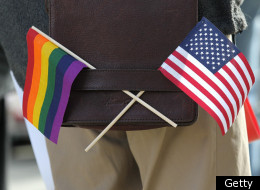
There is a bill being sent to Californian governor Jerry Brown that would require public schools in California to include time for studies of gay and lesbian contributions to society.
I feel like this is another well-intentioned idea that just ends up being a form of segregation. I've said before that things like black history month and gay pride parades just highlight the fact that these people are different. The idea of giving them special sections in a history course is potentially even worse. I'm not exactly sure what kind of contributions various gay people have made, but I feel like they would fall into one of two categories:
1. The contribution was of minimal significance, and the person is now "earning" a spot in a history lesson simply because they are gay.
2. The contribution was significant, and overshadows the fact that the person is gay. (In other words, they should be remembered for their contribution, not for their sexuality)
History is history, and important people and the important events they took part in should be the focus. Whether or not they were black, white, gay, man, woman, etc. can be interesting, but should not have anything to do with why we remember them.*
*of course I am well aware that often times historical events revolve around social issues that deal with sexuality/gender/races, in which case it makes perfect sense to note such things.
EDIT: I have realized that I wasn't considering the fact that social studies is not the same as history. Being required to include gay's in social studies lessons is absolutely a step forward. Perhaps this should be called a gay social studies bill instead.
Original Article:
http://www.huffingtonpost.com/2011/07/05/california-gay-history-bill_n_890846.html

2 comments:
I agree with you but the solution is not to avoid talk of differences all together. You have to strike a balance. When we talk about a famous person in school, unless we specify race and sexual orientation the assumption is still that they are white and straight. (I think an important step towards breaking the normal/different dichotomy is to always mention race/ethnicity and sexual orientation, rather than only doing it if the person is something other than straight and white!) Ideally we would not have a black history month or a gay history month – people from these demographics would be naturally and abundantly incorporated into all our curriculums; but they aren’t. CA’s gay history bill is an essential first step as it will require educators to research the contributions of gay people and give them visibility in the classroom and the world. As I see it, the goal, eventually, is to present these contributions alongside the contributions of straight women, black men, etc. in ways that emphasizes diversity, not differences (and I use “diversity” in it’s true sense, meaning “variety,” not “the inclusion of minorities” – as many people inaccurately use it). But in order to talk about diversity we MUST acknowledge differences, and we must do it in a positive light – examining the contributions of gay people through history is such a means.
There should not be a question as to whether a gay person’s contribution “overshadows” their sexual orientation, as you say. The point is not to “celebrate” being gay (because that does indirectly encourage superlative ideas and thus comparison, as well as highlight gayness as a person’s “defining” characteristic) but rather to have gayness simply be presented as part of a person - not prompting greatness or any other value judgment. The goal is to communicate the normalcy of homosexuality, and we cannot do that if we never talk about it. The conversation about famous gay people should be framed as: this person is great because they did this; this person is also gay.
Your suggestion that an educator might incorporate a gay person into their curriculum who’s contribution was of “minimal significance” illustrates how absent the “gayness” of famous people has been in our curricula thus far. Many of the people we already talk about in our classes are gay, we just exclude that piece of information. Most likely that exclusion began as an act of prejudice, now however it just seems not to be know by our teachers. To name a few famous gay people: Alexander the Great, Socrates, Marie Antoinette, Peter the Great, Walt Whitman, Oscar Wilde, Marcel Proust, Andy Warhol, Michelangelo, Leonardo Da vinci, Herman Melville, Tchaikovsky, Hans Christian Andersen… (see http://www.lambda.org/famous.htm).
To say that a famous person’s gender, sexual orientation or race “can be interesting but should not have anything to do with why we remember them” misses the point. When we teach, we are not just teaching a subject - we are teaching values (and I would argue the latter is more important). Who we talk about in class is who matters, and children absorb this. Gerald Unks puts it nicely: "Within the typical secondary school curriculum, homosexuals do not exist. They are 'nonpersons' in the finest Stalinist sense. They have fought no battles, held no offices, explored nowhere, written no literature, built nothing, invented nothing and solved no equations. The lesson to the heterosexual student is abundantly clear: homosexuals do nothing of consequence. To the homosexual student, the message has even greater power: no one who has ever felt as you do has done anything worth mentioning." -Gerald Unks, editor, The Gay Teen, p. 5.
Though only a first step on the path to creating truly inclusive classrooms that encourage social justice, the CA Gay History Bill will help give gay people the visibility they deserve and our students deserve.
I think an important distinction that we are both forgetting to make is the difference between history and social studies. Having a section for gays in a social studies lesson makes perfect sense, and would be a good time to mention all the historic people that were gay. However, during the history lesson, I feel like the focus should be on the events. Then again, history books tend to have those little side bars with additional information, and that would be a good spot to put in more things about personal life.
My point is, when I was in junior high studying the American Revolution and The Civil War, there was always a chapter for "Women's involvement in the war" and a chapter for "Black involvement in the war" and that is what I'm afraid of seeing more of.
Post a Comment